
Post
36 Porsche 918 Spyder
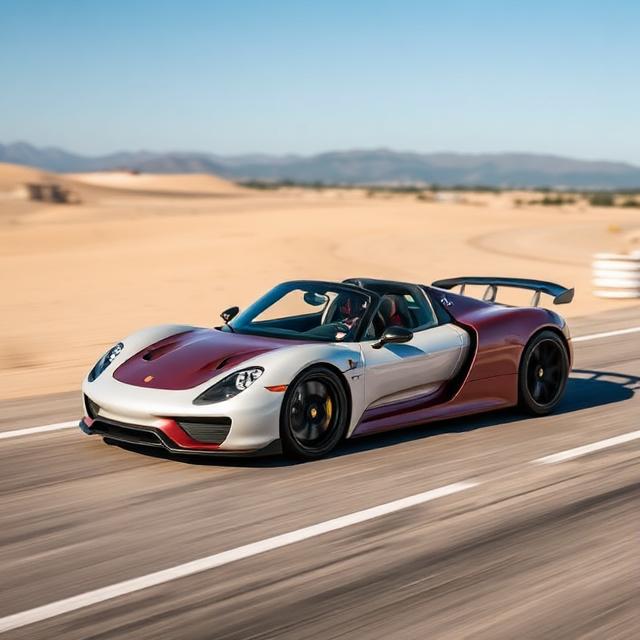
Jun
The Porsche 918 Spyder: Defining the Zenith of Hybrid Supercar Engineering
https://en.wikipedia.org/wiki/Main_Page
The automotive world is punctuated by milestones—moments where the trajectory of engineering shifts irrevocably. For Porsche, the 918 Spyder represents more than just a flagship vehicle; it is a declaration of intent. Released as the successor to the legendary Carrera GT and the spiritual heir to the 959, the 918 Spyder did not merely push the boundaries of performance; it redefined the very concept of the hypercar by proving that electrification and visceral, high-octane performance are not mutually exclusive—they are complementary.
A Legacy of Innovation Porsche 918 Spyder
To understand the 918 Spyder, one must appreciate the context of its birth. In the early 2010s, the automotive industry was grappling with the necessity of efficiency. Porsche, a brand defined by the flat-six engine and the purity of the 911, faced the challenge of marrying its racing heritage with the looming mandate for sustainability. Porsche 918 Spyder
The solution was the “Holy Trinity” of hypercars: the Ferrari LaFerrari, the McLaren P1, and the Porsche 918 Spyder. While its competitors focused on track-focused aggression, the 918 Spyder approached the problem with German clinical precision and a level of daily-drivable versatility that remains industry-leading today. Porsche 918 Spyder
The Heart of the Beast: The Powertrain
At the core of the 918 Spyder lies a technical masterpiece: a 4.6-liter naturally aspirated V8 engine derived from the Porsche RS Spyder LMP2 racing car. On its own, this high-revving engine produces 608 horsepower—an impressive figure for a naturally aspirated unit. However, the true magic occurs when this internal combustion engine is synchronized with two electric motors.
One motor is positioned on the rear axle, paired with the seven-speed PDK (Porsche Doppelkupplung) transmission, while the second motor drives the front axle. This combination creates an “electric all-wheel-drive” system, allowing for unparalleled torque vectoring and traction management. The cumulative output is a staggering 887 horsepower and 944 lb-ft of torque.
The result is a performance figure that defies Newtonian physics for a vehicle of its weight. The 918 Spyder catapults from 0 to 60 mph in 2.2 seconds and continues to a top speed of 214 mph. Yet, it operates with a dual personality: it can be a stealthy EV capable of silent, emissions-free urban commuting, or a fire-breathing track weapon. Porsche 918 Spyder
Chassis and Aerodynamics: Sculpted by Speed
The 918 Spyder’s chassis is a carbon-fiber-reinforced plastic (CFRP) monocoque, ensuring extreme rigidity while keeping the weight focused low. The placement of the liquid-cooled lithium-ion battery pack behind the passenger cell further lowers the center of gravity, contributing to the car’s razor-sharp handling. Porsche 918 Spyder
Aerodynamics play a critical role in the 918’s stability. The car features an adaptive aerodynamic system with three distinct states:
- Race Mode: The rear wing extends to a steep angle, and the under-body air flaps close, maximizing downforce for circuit performance.
- Sport Mode: The wing adjusts to a mid-point, balancing downforce with drag reduction.
- E-Mode: The wing retracts, and the flaps open to create a minimal-drag profile, optimizing the car for maximum electric efficiency.
The iconic “top-exit” exhaust system—where the pipes exit directly above the engine block—was not merely a stylistic choice. It reduces backpressure and heat degradation around the battery components while creating a sound profile that is uniquely raw and intoxicating. Porsche 918 Spyder
The Driver-Centric Cockpit
Inside the 918 Spyder, the philosophy of “form follows function” is executed with luxury. The cockpit is intentionally minimalist, focusing the driver’s attention on the road and the steering wheel. The center console rises toward the driver, housing the haptic-touch controls for the climate and infotainment systems.
Despite its hypercar status, the interior is surprisingly ergonomic. The bucket seats provide exceptional lateral support for high-G cornering while remaining comfortable enough for long-distance grand touring. Every material—from the Alcantara upholstery to the exposed carbon fiber weaves—speaks to a level of craftsmanship synonymous with Porsche’s Exclusive Manufaktur division.
The Hybrid Advantage
Perhaps the most significant achievement of the 918 Spyder is proving that hybrid technology can enhance the driving experience rather than dilute it. The electric motors provide instant torque, filling the “torque gaps” inherent in traditional internal combustion engines. During low-speed maneuvers or when coasting, the electric motors allow for seamless efficiency, but when the throttle is mashed, the synergy between fuel and electricity is instantaneous.
This is not a “green” car in the traditional sense; it is a performance car that uses electricity as a force multiplier. It provides a level of responsiveness that a pure ICE engine simply cannot match, establishing the blueprint for the modern era of high-performance vehicle development.
The Weissach Package: The Track-Focused Alter Ego
For those seeking the absolute limit, Porsche offered the “Weissach Package.” This optional upgrade stripped away comfort features like air conditioning, audio systems, and even exterior paint (replacing it with a thin wrap) to save every possible gram of weight. Porsche 918 Spyder
Beyond weight reduction, the Weissach edition features lightweight magnesium wheels, ceramic wheel bearings, and titanium bolts. These changes, combined with additional aerodynamic carbon-fiber elements—such as the front flics and rear winglets—turn the 918 into a focused, brutal track machine that shaved seconds off lap times, most notably setting a then-record time of 6:57 on the Nürburgring Nordschleife.
A Collectible Masterpiece Porsche 918 Spyder
With only 918 units ever produced, the scarcity of the Porsche 918 Spyder has cemented its status as one of the most desirable automobiles in history. It represents a “closing of the chapter” on the analog-digital transition, capturing the best of the naturally aspirated era while embracing the inevitable electrification of the future.
As the automotive industry shifts toward full battery-electric vehicles, the 918 Spyder remains a monument to what is possible when there are no compromises. It is reliable enough to drive to the grocery store, efficient enough to use in city traffic, and fast enough to humble dedicated race cars on a circuit.
Conclusion: The Timeless Benchmark Porsche 918 Spyder
To own a Porsche 918 Spyder is to own a piece of automotive history. It stands as a bridge between the classic, visceral sports cars of the 20th century and the high-tech, intelligent machines of the 21st. The 918 Spyder didn’t just meet the expectations set by its predecessors; it shattered them by introducing a new language for what a supercar could be.
Whether it is the haunting whine of the electric motors melding with the roar of the V8, or the sight of the silhouette cutting through the air, the 918 Spyder is a sensory experience. It is a masterclass in hybrid engineering, a testament to Porsche’s relentless pursuit of perfection, and, quite simply, one of the greatest automobiles ever created. For the collector, the enthusiast, and the driver, it remains the ultimate benchmark. Porsche 918 Spyder
https://zenopen.click/category/post
