
Post
56 Porsche 959
Jun
The Porsche 959: Engineering Perfection and the Dawn of the Supercar Era
https://en.wikipedia.org/wiki/Main_Page
In the annals of automotive history, few vehicles command the reverence, awe, and intellectual curiosity of the Porsche 959. More than just a car, the 959 was a manifesto—a high-speed research laboratory on wheels that effectively bridged the gap between analog performance and the digital-mechanical complexity of the modern supercar.
When it debuted in prototype form at the 1983 Frankfurt Motor Show as the “Gruppe B,” the automotive world was caught off guard. When it reached production in 1986, it didn’t just set a new benchmark; it rendered the competition obsolete. To understand the Porsche 959 is to understand the moment Porsche decided to stop just building sports cars and start engineering the future.
1. The Genesis: Born from the Chaos of Group B
To appreciate the 959, one must look at the landscape of 1980s motorsport. The FIA’s Group B rally series was the “Wild West” of racing—a category with virtually no restrictions on power, weight, or technology, leading to cars that were as lethal as they were revolutionary. Porsche, typically associated with circuit racing, pivoted into this arena not for the sake of the trophy alone, but for the sake of development.
The 959 was designed as a homologation special, but it was over-engineered from the first bolt. While its rivals in the rally circuit were often stripped-out, raw machines, the 959 was built with the intent of creating an all-weather, all-terrain, high-performance masterpiece. It was a car that could thrive on the loose gravel of a rally stage and hit 197 mph on the Autobahn.
2. Propulsion: The Twin-Turbo Marvel
At the heart of the 959 lies a 2.85-liter flat-six engine that remains a masterclass in internal combustion engineering. While Porsche was already a pioneer in turbocharging with the 930 Turbo, the 959 took it a step further with a sequential twin-turbocharging system.
This was a radical departure from the norm. At low engine speeds, the smaller turbocharger provided immediate boost, eliminating the notorious “turbo lag” that plagued the era’s performance cars. As the rev counter climbed, a larger turbocharger would spool up, providing monstrous mid-to-high range power.
Producing 444 horsepower and 369 lb-ft of torque, the engine was a liquid-cooled marvel in a sea of air-cooled traditions. The cylinder heads were water-cooled, while the block remained air-cooled—a hybrid cooling strategy that allowed for the high compression ratios necessary to unlock such performance without succumbing to thermal failure.
3. The “Porsche-Steuer Kupplung” (PSK): A Revolution in Traction
If the engine was the heart of the 959, the drivetrain was its soul. Porsche introduced the PSK (Porsche-Steuer Kupplung) system, perhaps the most advanced all-wheel-drive setup the world had ever seen at the time.
Unlike the static AWD systems of the day, the PSK was electronically controlled. It could proactively adjust the torque split between the front and rear wheels based on throttle position, steering angle, and tire slip. In a straight line under hard acceleration, the car could send up to 80% of its power to the rear wheels to maximize traction; in corners, it could shift that power frontward to pull the car through the apex with unnatural stability.
This system transformed the 959 from a temperamental rear-engine widow-maker into a car that gripped the tarmac with unflappable confidence. It turned advanced physics into a seamless driving experience.
4. Design and Aerodynamics: Function Dictating Form
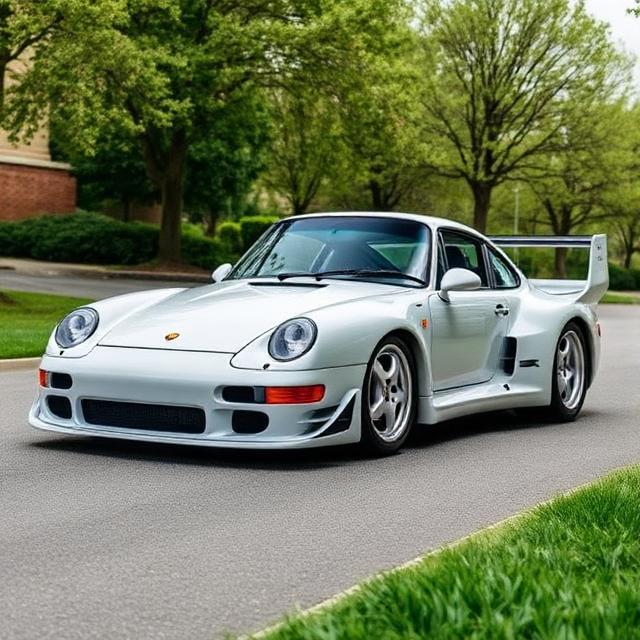
The silhouette of the 959 is unmistakable. While it clearly shares the DNA of the 911, the 959 was radically different under the skin. To achieve its target top speed, Porsche focused heavily on drag reduction. With a drag coefficient of just 0.31, the 959 was remarkably slippery, utilizing a smooth, integrated bumper design, a flat floor, and the iconic “whale tail” spoiler—which, unlike its predecessors, was functional and integrated into the bodywork to generate downforce without increasing drag.
The body panels were constructed from a combination of aluminum and Kevlar-reinforced composite plastics, keeping weight low while maintaining structural integrity. Every vent, every curve, and every angle served a specific aerodynamic purpose, proving that Porsche’s engineers were as focused on airflow as they were on horsepower.
5. Technology Ahead of Its Time
Stepping inside a 959 today, one might be surprised by the analog charm, but hidden beneath the dashboard was a nervous system far ahead of its decade. The 959 featured:
- Adjustable Ride Height: Drivers could lower or raise the suspension on the fly, a feature that wouldn’t become standard in supercars for another two decades.
- Run-Flat Tires: It was one of the first production cars to feature specialized run-flat tires equipped with pressure sensors.
- Advanced Telemetry: The dashboard provided the driver with real-time feedback on torque distribution and tire pressure—monitoring systems that are now commonplace but were considered science fiction in 1986.
6. The Legacy: The Blueprint for the Modern Supercar
The Porsche 959 was not a profitable venture. In fact, Porsche lost money on every single unit produced. However, its value wasn’t measured in revenue; it was measured in knowledge. The 959 served as the testbed for the all-wheel-drive technology that would define the 911 Turbo for the next 30 years. It solidified Porsche’s reputation as the masters of high-performance engineering, and its influence can be seen in everything from the 993 Turbo to the modern 918 Spyder.
Only 337 examples of the 959 were produced, making it one of the most coveted collectibles in automotive history. Owners today treat them not just as museum pieces, but as the ultimate driving machines. Despite being over 35 years old, a well-maintained 959 can still comfortably keep pace with, or outperform, many modern sports cars.
7. Conclusion: The Eternal Benchmark
The Porsche 959 represents a “clean-sheet” approach to excellence. It was a car that didn’t follow trends—it shattered them. It proved that a sports car could be fast, luxurious, civil, and incredibly capable all at once.
For the enthusiast, the 959 is the holy grail. For the engineer, it is a masterclass in problem-solving. And for the automotive world at large, it remains a testament to what happens when there are no compromises, no limits, and an unwavering commitment to engineering perfection. The Porsche 959 didn’t just win its race; it changed the race forever, setting a standard of innovation that continues to drive the spirit of Porsche to this very day.
Whether idling at rest or carving through a mountain pass, the 959 stands as a silent giant—a reminder that while trends fade, true innovation is timeless.
https://zenopen.click/category/post
