
Post
54 Pagani Utopia
Jun
Pagani Utopia: The Art of Pure Driving Emotion
https://en.wikipedia.org/wiki/Main_Page
In an era dominated by the relentless march toward electrification, autonomous systems, and digital immersion, the Pagani Utopia stands as a defiant monument to the analog soul of the automobile. It is not merely a vehicle; it is a manifestation of Horacio Pagani’s lifelong obsession with the intersection of art and science. The Utopia is the third chapter in the Pagani lineage, following the iconic Zonda and the record-shattering Huayra. It represents a “reductive” philosophy—a deliberate stripping away of the unnecessary to reveal the raw, unadulterated essence of high-performance motoring.
This is a machine built for the purist, for the connoisseur, and for those who believe that a car should be felt as much as it is driven.
1. The Genesis: Philosophy Over Numbers Pagani Utopia
When Horacio Pagani began conceptualizing the Utopia, he consulted with his most loyal clients—the collectors who have lived and breathed his creations for decades. The consensus was clear: they did not crave more complex hybrid systems, nor did they demand a car that drove itself. They craved simplicity, lightness, and the visceral connection provided by a manual gearbox.
The Utopia was born from a desire to escape the “digital noise” of modern supercars. It is an exercise in elegance, where every bolt, every carbon-fiber weave, and every hand-stitched leather seam tells a story of craftsmanship. It is the antithesis of the current trend of “numbers-only” performance, prioritizing the human experience above the stopwatch.
2. Design: The Symphony of Aerodynamism Pagani Utopia
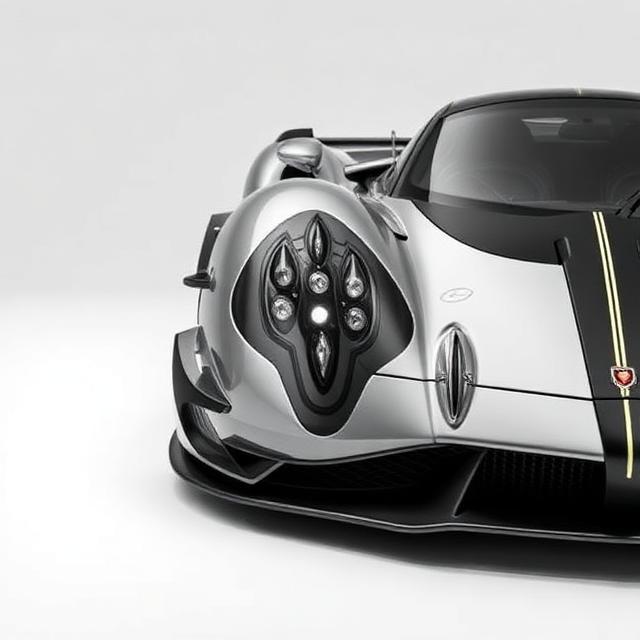
The visual language of the Pagani Utopia is a departure from the aggressive, serrated edges often found in the hypercar segment. Instead, it embraces a timeless, sculptural fluidity. Inspired by the principles of Leonardo da Vinci—where art and science coalesce—the Utopia’s bodywork is a masterclass in aerodynamic efficiency achieved without the need for cumbersome spoilers or wings. Pagani Utopia
The Exterior
The silhouette is unmistakably Pagani, characterized by its rounded, organic cockpit and the iconic quad-exhaust system. However, every intake and vent serves a purely functional purpose. The “floating” rear lights, the turbine-style wheels, and the active aerodynamic elements work in silent harmony to keep the car planted. The body is constructed from Pagani’s proprietary Carbo-Titanium HP62 G2 and Carbo-Triax HP62, materials that offer the strength of carbon fiber with the flexibility and lightness of aerospace-grade composites. Pagani Utopia
The Interior: An Analog Sanctuary
To step inside the Utopia is to step into a steampunk dreamscape. There are no expansive touchscreens, no distracting digital menus, and no unnecessary interfaces. The dashboard is dominated by a cluster of analog dials—the “instruments of a cockpit”—each one machined from a solid block of aluminum.
Every switch is a piece of jewelry, tactile and weighted to perfection. The steering wheel, milled from a single block of aluminum and adorned with fine leather, feels like a sculptural extension of the hand. The visible gear linkage—a hallmark of the manual transmission option—is a mechanical ballet, exposed for the driver to witness the precise engagement of gears as they shift.
3. The Powerplant: AMG-Pagani Alchemy
At the heart of the Utopia lies the Mercedes-AMG 6.0-liter twin-turbo V12 engine. Developed exclusively for Pagani, this engine is not an off-the-shelf component; it is a bespoke fire-breathing masterpiece.
Producing 864 horsepower and a staggering 1,100 Nm of torque, the engine is designed to deliver power linearly, without the typical lag associated with forced induction. It is a naturally aspirated character in a forced-induction body, providing a deep, guttural roar that has been tuned specifically to resonate with the driver’s senses via a lightweight titanium exhaust system. The sound is not merely noise; it is a musical composition, engineered to provide a unique acoustic signature that changes as the revs climb toward the 6,700 RPM limit.
4. Engineering the Engagement
The Utopia offers two transmission choices, both developed in partnership with Xtrac: a pure, seven-speed manual or an automated manual transmission (AMT).
The manual gearbox is the highlight for the true driving enthusiast. In a world where the manual is becoming extinct, Pagani has engineered a transmission that handles the immense torque of the V12 while providing the crisp, mechanical feedback that defines a soulful drive. The engagement is firm, deliberate, and deeply rewarding. For those who prefer the speed of a dual-clutch, the AMT offers lighting-fast shifts that keep the engine in its power band with surgical precision.
Chassis and Handling
The Utopia utilizes a double-wishbone suspension system made of forged aluminum alloy. This setup, combined with electronically controlled shock absorbers, allows the car to switch between a grand touring comfort and a track-ready responsiveness at the flick of a switch. Despite the immense power, the Utopia remains surprisingly light—weighing in at just 1,280 kg (2,822 lbs). This power-to-weight ratio ensures that the driving experience is agile, nimble, and intensely communicative.
5. The Pagani Legacy: A Collector’s Investment
Owning a Pagani is not merely a transaction; it is an entry into the “Pagani family.” Every Utopia is unique, built to the exact specifications of its owner through the Grandi Complicazioni department. From the choice of bespoke leather hides sourced from the finest Italian tanneries to the intricate patterns in the visible carbon fiber, the customization possibilities are virtually infinite.
Because each Utopia is hand-assembled in the San Cesario sul Panaro atelier in limited numbers, the car is an artifact of extreme rarity. It is designed to be a centerpiece of any collection, a car that will be as breathtaking to look at in fifty years as it is today. Unlike mass-manufactured “limited edition” supercars that often lose their luster as technology advances, the Utopia is protected by its analog purity. It is immune to the obsolescence of software updates and digital interfaces.
6. Living with the Utopia
While the Utopia is a hypercar, it is significantly more usable than its predecessors. Horacio Pagani designed the car with “Grand Touring” in mind. The cabin is spacious, the visibility is excellent for a mid-engine exotic, and the suspension compliance allows for long-distance journeys across coastal roads or mountain passes without the driver feeling fatigued. It is a car that asks to be driven, not just admired behind a velvet rope.
7. Conclusion: The Utopian Ideal
In the final analysis, the Pagani Utopia is a statement of defiance. It tells the world that the pinnacle of automotive engineering is not found in a battery pack or an algorithm, but in the friction of rubber on asphalt, the mechanical click of a gear shift, and the roar of a V12 engine behind one’s ears.
It is a tribute to the craftsmen, the engineers, and the dreamers who believe that the automobile is the greatest expression of human liberty. With the Utopia, Horacio Pagani has captured the fleeting magic of a bygone era and refined it into something that feels entirely new. It is the realization of an ideal—a perfect, harmonious, and utterly breathtaking masterpiece.
To drive the Pagani Utopia is to experience driving as it was always meant to be: a visceral, emotional, and transcendent dialogue between man and machine. It is, quite simply, the end of the road for those who seek the ultimate driving experience.
For inquiries regarding commission and bespoke configuration, please contact your local Pagani representative to begin your journey into the Utopia.
https://zenopen.click/category/post
